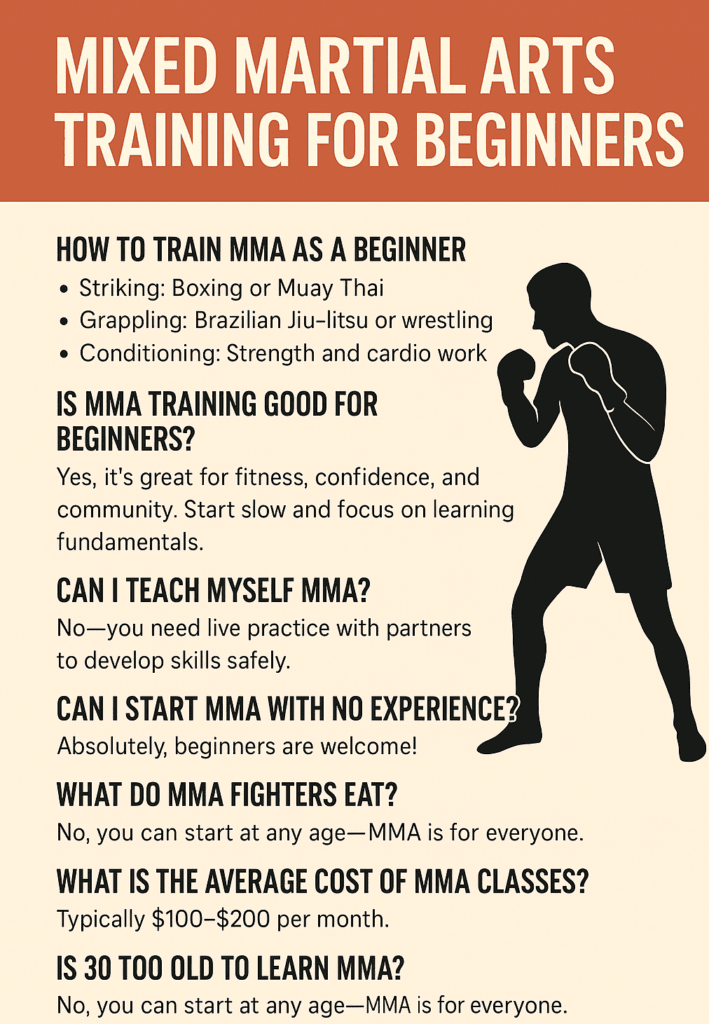
Mixed Martial Arts (MMA) has exploded in popularity over the last two decades, thanks to the UFC and stars like Conor McGregor, Khabib Nurmagomedov, and Amanda Nunes. But MMA isn’t just about stepping into a cage—it’s a challenging, rewarding sport that combines multiple martial arts into one system.
Mixed Martial Arts (MMA) training combines techniques from multiple disciplines such as boxing, wrestling, Brazilian jiu-jitsu, and Muay Thai to build strength, endurance, and skill. According to the UFC Performance Institute, beginner MMA training focuses on foundational movement, conditioning, and proper technique rather than full contact, helping newcomers build confidence and fitness safely.

For beginners, the world of MMA can feel intimidating. Questions like “Can I train if I’ve never fought before? Am I too old to start? How much does it cost?” are extremely common. The good news? You don’t need to be a professional fighter to benefit from MMA training. Whether your goal is fitness, self-defense, or competition, MMA can be adapted for you.
—
How to Train MMA as a Beginner
The best way to train MMA as a beginner is to start with the foundational martial arts disciplines that make up the sport:
– Striking: Boxing, kickboxing, or Muay Thai.
– Grappling: Brazilian Jiu-Jitsu (BJJ), wrestling, or judo.
– Conditioning: Strength and cardio work to build stamina.
A typical beginner MMA week might include:
– 2 days striking (boxing or Muay Thai basics).
– 2 days grappling (BJJ or wrestling drills).
– 1–2 days conditioning (circuits, strength training, running).
For beginners, MMA training is less about fighting and more about learning movement patterns, improving conditioning, and developing coordination. Verywell Fit explains that starting with basic drills, light resistance training, and controlled practice allows beginners to improve fitness and skills while minimizing injury risk.
Most MMA gyms have structured beginner classes that blend these elements into one.
—
Is MMA Training Good for Beginners?
Yes, MMA training can be excellent for beginners—if you approach it correctly. The benefits go far beyond fighting:
– Fitness: MMA is one of the best full-body workouts you can do.
– Confidence: Learning self-defense builds mental toughness.
– Community: Gyms often have a family-like atmosphere where everyone supports each other.
That said, it’s important to start slow. Focus on technique before intensity, and don’t compare yourself to advanced fighters—you’re building a foundation.
—
How Should a Beginner Learn Martial Arts?
Beginners should focus on three steps:
1. Pick a starting discipline. Don’t try to learn everything at once. For example, you might start with BJJ for ground fighting or boxing for striking.
2. Find a good gym or instructor. The right coach makes all the difference. Look for one that emphasizes fundamentals and safety.
3. Be consistent. Two to three classes per week is plenty to see progress as a beginner.
The key is patience—martial arts skills take years to master, but every class moves you forward.
—
Can I Teach Myself MMA?
Realistically, no—you can’t fully teach yourself MMA. While you can improve conditioning, shadowbox, or study techniques online, martial arts require live practice with partners.
Here’s why:
– Striking: You need feedback on form, timing, and defense.
– Grappling: It’s impossible to learn joint locks, sweeps, or escapes without a partner.
– Safety: Coaches prevent bad habits that could cause injury.
That said, self-study can supplement gym training. Watching fights, drilling footwork, and doing solo cardio will help you progress faster.
—
Can I Start MMA With No Experience?
Absolutely! In fact, most MMA beginners start with no martial arts background. Gyms usually offer fundamental classes specifically for newcomers.
You don’t need to be fit, flexible, or tough to begin—MMA training will naturally build these qualities. The only requirement is an open mind and willingness to learn.
—
What Do MMA Fighters Eat?
Diet is crucial for both performance and recovery. While fighters preparing for competition may follow strict weight-cutting plans, everyday MMA trainees can focus on balanced nutrition:
– Protein: Lean meats, fish, eggs, beans (for muscle repair).
– Carbs: Rice, oats, potatoes, whole grains (for energy).
– Fats: Avocados, nuts, olive oil (for joint health and hormones).
– Vegetables & Fruits: Micronutrients and fiber.
– Hydration: Plenty of water—MMA training is sweaty work!
A simple rule: eat clean, whole foods, and avoid processed junk.
—
Is 30 Too Old to Learn MMA?
Not at all. Many people start MMA in their 30s, 40s, or even 50s. While you may not become a UFC champion, you can absolutely learn the sport, get in great shape, and even compete at amateur levels.
Benefits for older beginners include:
– Improved fitness and mobility.
– Better stress relief.
– A sense of community.
As long as you train smart—focusing on technique and avoiding reckless sparring—you’re never too old to start MMA.
—
What Is the Average Cost of MMA Classes?
Costs vary by location and gym, but here’s a rough guide:
– Monthly membership: $100–$200 (includes multiple classes weekly).
– Drop-in classes: $15–$30 per session.
– Private lessons: $50–$100+ per hour.
Some gyms offer trial classes or beginner packages, so you can test it out before committing. Consider the investment in both fitness and self-defense—it’s worth it.
—
Common Beginner Struggles in MMA
– Cardio fatigue: MMA is exhausting—your stamina will build with time.
– Information overload: There’s a lot to learn. Focus on basics before advanced moves.
– Nervousness sparring: Everyone feels this at first. Start slow, and you’ll gain confidence.
The key is to push through early discomfort. Every fighter you admire once struggled with the same issues.
—
Closing Thoughts
MMA training is an incredible journey that challenges your body, mind, and spirit. As a beginner, remember these essentials:
– Start with the basics—boxing, BJJ, or Muay Thai.
– Don’t worry about experience—everyone starts somewhere.
– You can’t fully teach yourself—find a gym or coach.
– You’re never too old—30, 40, or beyond, MMA is for anyone.
– Eat clean, stay consistent, and focus on learning, not just fighting.
Whether you’re aiming to compete or just want a fun, empowering workout, MMA offers something for everyone. The cage isn’t the only reward—the real victory is in the discipline, fitness, and confidence you build along the way.