When you hear the word “fitness,” you might think of building muscle, running miles, or lifting heavy weights. But there’s another piece of the puzzle that determines how well you move, how strong you feel, and how long you stay injury-free: your mobility.
Mobility training focuses on improving how your joints move through their full range of motion with control and stability. According to the National Academy of Sports Medicine, mobility differs from flexibility by emphasizing active movement and joint control rather than passive stretching, making it especially important for beginners who want to move better and reduce injury risk.
Mobility is the secret ingredient that helps you move freely, squat deeper, run smoother, and recover faster. Without it, you’re more likely to feel stiff, struggle with workouts, or even get sidelined with injuries. The good news? You can train mobility just like strength or cardio—and the results carry over into everything you do.
Let’s break down what mobility really is, examples of mobility training exercises, and the answers to the most common questions you probably have about adding mobility to your fitness routine.

What Are Examples of Mobility Training Exercises?
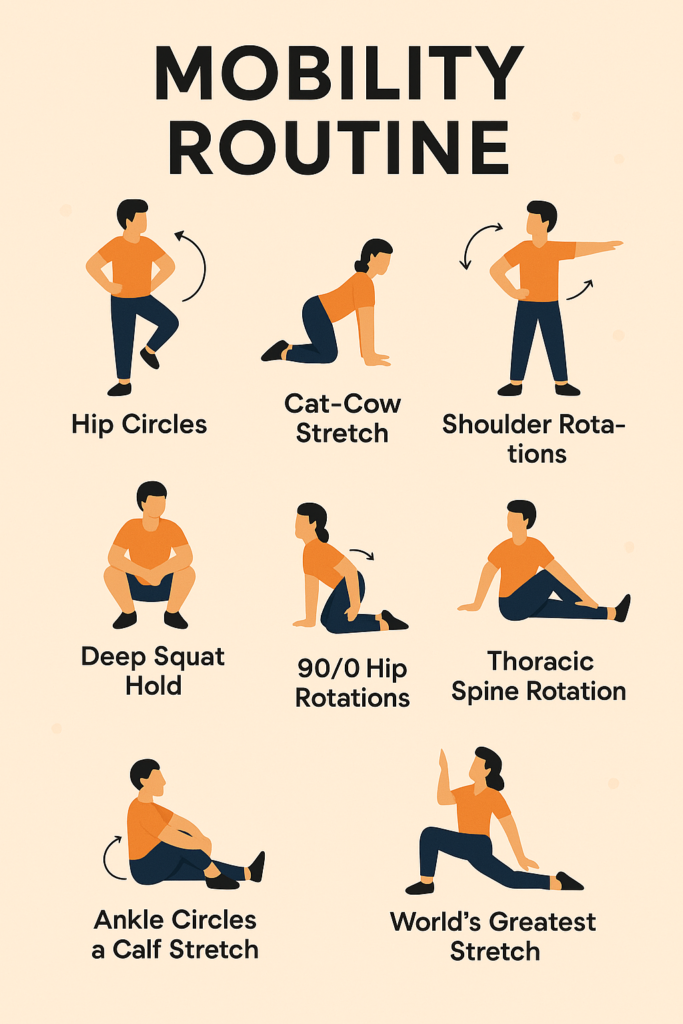
Mobility exercises help improve joint health, movement efficiency, and functional strength in everyday activities. pliability highlights that mobility training can enhance coordination, reduce stiffness, and support safer movement patterns when exercises target major joints like the hips, shoulders, spine, and ankles. Mobility exercises focus on improving how well your joints move through their full range of motion. They often combine movement and stretching to train both flexibility and control. Here are some examples you can start using:
– Hip Circles – Stand tall and slowly move your hip joint in a circle. This warms up and loosens tight hips.
– Cat-Cow Stretch – On hands and knees, alternate between arching and rounding your back. Great for spine mobility.
– Shoulder Rotations – Use a resistance band or broomstick to rotate your shoulders forward and backward.
– Deep Squat Hold (Third World Squat) – Sit into a deep squat and hold to open up your hips and ankles.
– 90/90 Hip Rotations – Sit with legs bent at 90 degrees on each side and rotate from side to side to work on hip mobility.
– Ankle Circles and Calf Stretch – Loosen stiff ankles that often limit squats and lunges.
– Thoracic Spine Rotations – Kneel or sit, place one hand behind your head, and rotate your upper body side to side.
These exercises target common problem areas like your hips, shoulders, spine, and ankles—key joints for both daily life and athletic movement.
What Is the 3-Day Mobility Program?
A 3-day mobility program is a simple structure that spreads mobility training across your week without overwhelming you. Here’s an example:
Day 1 – Lower Body Focus (hips, knees, ankles)
– Hip circles – 2 minutes
– Deep squat hold – 3 x 30 seconds
– Ankle circles + calf stretch – 2 minutes each side
Day 2 – Upper Body Focus (shoulders, spine)
– Shoulder rotations with band – 2 minutes
– Cat-Cow – 10 reps
– Thoracic spine rotations – 3 x 10 each side
Day 3 – Full Body Flow
– 90/90 hip rotations – 3 x 5 per side
– Downward Dog to Cobra Flow – 5 reps
– World’s Greatest Stretch (lunge + rotation) – 5 per side
Each session takes just 10–15 minutes. That’s enough to notice a big improvement in how your body feels and moves.
What Is Mobility in a Workout?
Mobility in a workout means how well your joints can move freely and with control. For example:
– If you squat deep without your heels lifting, that’s good ankle and hip mobility.
– If you can press overhead without arching your back, that’s good shoulder mobility.
Mobility is the bridge between flexibility (your ability to stretch) and strength (your ability to apply force). It’s not just about touching your toes—it’s about controlling your body in real movement.
What Is an Example of Mobility?
A classic example is the World’s Greatest Stretch:
– Step into a lunge.
– Place both hands on the ground inside your front foot.
– Rotate your upper body, lifting one arm toward the sky.
This one move works your hips, spine, shoulders, and hamstrings all at once. It’s the perfect example of mobility because it combines flexibility with movement and control.
Is Mobility Training Just Stretching?
No—it’s more than stretching.
– Stretching lengthens your muscles and improves flexibility.
– Mobility training improves the way your joints move through their range of motion with control and stability.
Think of stretching as sitting down and holding a hamstring stretch. Mobility, on the other hand, is doing walking lunges with a twist—actively moving while stretching.
Both are valuable, but mobility training gives you better carryover to workouts and daily life.
Which Are the Four Types of Training to Improve Mobility?
There are four main approaches you can use to improve your mobility:
1. Dynamic stretching – Moving stretches, like leg swings or arm circles, to warm up.
2. Static stretching – Holding a stretch for 20–60 seconds, like a seated hamstring stretch.
3. Foam rolling (self-myofascial release) – Massaging tight muscles to release tension.
4. Joint mobility drills – Controlled movements, like hip rotations or ankle circles, that specifically target your joints.
Mixing all four gives you the best results because you’re addressing tight muscles, stiff joints, and movement control.
Can I Do Mobility Exercises Every Day?
Yes—you can and you should. Mobility training is gentle on your body and can be done daily. Even just 10 minutes a day will:
– Reduce stiffness
– Improve posture
– Help prevent injuries
– Make your workouts more effective
Think of mobility like brushing your teeth—it’s daily maintenance for your body.
Final Thoughts
Mobility training isn’t flashy, but it’s one of the most valuable things you can do for your body. From hip circles and Cat-Cows to deep squat holds and thoracic spine rotations, these exercises improve how you move, how you feel, and how you perform.
By following a simple program like the 3-day mobility plan—or just doing a few drills daily—you’ll loosen stiff joints, reduce aches, and make strength training and cardio workouts easier.
So don’t just focus on lifting heavier or running faster. Add mobility into your routine, and you’ll unlock a new level of freedom in how you move every day.