If you’ve been curious about Pilates but unsure where to begin, you’re not alone. Many people see Pilates as something for dancers, athletes, or ultra-flexible people, but the truth is: Pilates is one of the best workouts for beginners.
Pilates is a low-impact exercise method that focuses on controlled movements, core strength, posture, and breathing. According to the Pilates Method Alliance, Pilates emphasizes precision, alignment, and mindful movement, making it an excellent option for beginners looking to build strength and stability safely.
It’s gentle on your joints, builds strength in your core, improves posture, and tones your body without heavy weights. Whether you want to get stronger, move better, or feel more balanced, Pilates is a great place to start.
Let’s break down the essentials of Pilates for beginners and answer the most common questions to help you start your journey.
How Long Should a Pilates Workout Be for Beginners?
As a beginner, 20–30 minutes is enough for a Pilates session. You don’t need an hour-long workout to feel results—Pilates is all about slow, controlled movements that activate your muscles in a deep way.
Start with shorter routines 2–3 times per week. As your stamina improves, you can increase your sessions to 40–50 minutes.
What Is a Good Pilates Routine for Beginners?
Pilates offers a wide range of physical benefits, particularly for core strength and posture. The Cleveland Clinic explains that Pilates can improve flexibility, balance, and muscular endurance while being gentle on the joints, making it suitable for beginners and those returning to exercise.
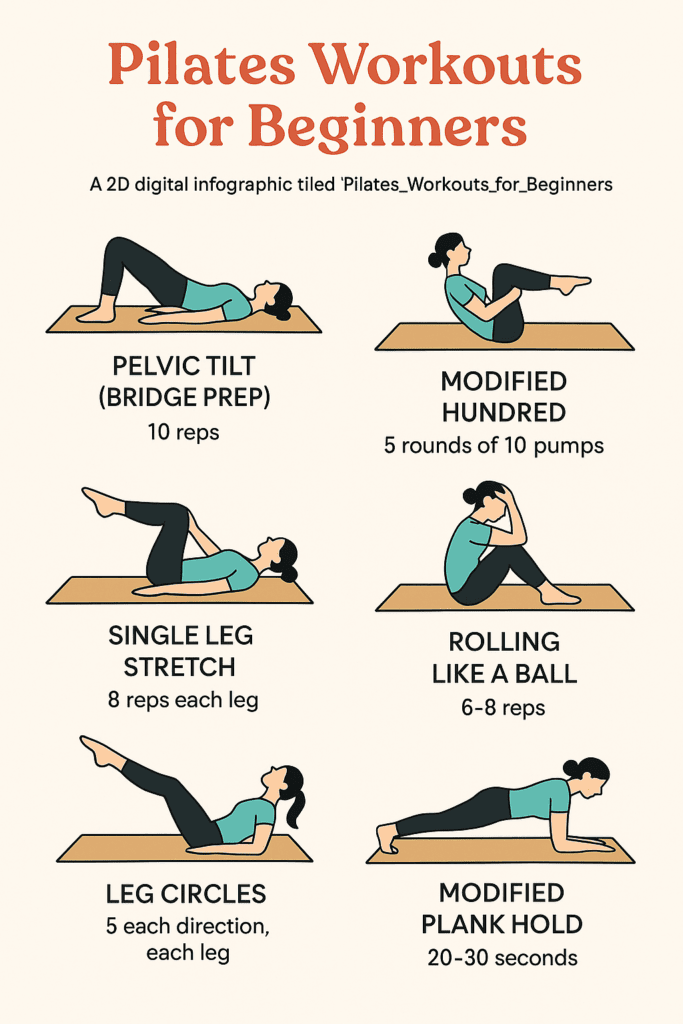
Here’s a simple 20-Minute Beginner Pilates Routine (no equipment needed):
1. Pelvic Tilt (Bridge Prep) – 10 reps
2. Hundred (Modified) – 5 rounds of 10 pumps
3. Single Leg Stretch – 8 reps each leg
4. Rolling Like a Ball – 6–8 reps
5. Leg Circles – 5 each direction, each leg
6. Plank Hold (Modified on knees) – 20–30 seconds
7. Cat-Cow Stretch – 5 rounds
Focus on controlled breathing, engaging your core, and moving slowly rather than rushing.
What Is the 10-20-30 Rule in Pilates?
The 10-20-30 rule is a principle often used in Pilates:
– 10 sessions – You’ll start to feel a difference in your body (better posture, stronger core).
– 20 sessions – You’ll start to see visible changes (toning, flexibility).
– 30 sessions – You’ll have a whole new body awareness and improved strength.
This rule highlights the importance of consistency in Pilates. Results don’t happen overnight, but steady practice pays off.
Is Pilates Good for Beginner Workouts?
Yes—Pilates is one of the best workout methods for beginners.
Why?
– It’s low-impact, so it’s gentle on your joints.
– It builds strength from the inside out, especially your core.
– It improves flexibility and posture.
– It can be done with just a mat—no gym required.
Pilates is accessible, safe, and effective for all ages and fitness levels.
Does Pilates Actually Tone Your Body?
Yes—Pilates is excellent for toning and sculpting. Instead of bulking muscles, Pilates lengthens and strengthens them. This gives you a leaner, more defined look.
– Core muscles become tighter and stronger.
– Arms and legs become lean and toned.
– Improved posture makes you look taller and more confident.
If your goal is to look toned without heavy lifting, Pilates is perfect.
Can I Teach Myself Pilates?
Yes—you can teach yourself Pilates at home with videos, apps, or books. Here’s how:
1. Start with beginner Pilates videos. YouTube channels like Blogilates or Pilates Anytime are great resources.
2. Focus on form. Pilates is precise, so follow instructions carefully.
3. Start slow. Don’t rush through movements—quality is more important than quantity.
4. Consider a class. If possible, take at least one in-person or online class to learn proper alignment.
Self-practice is fine, but make sure you’re paying attention to posture and breathing.
Can Pilates Help You Lose Weight?
Yes, but indirectly. Pilates alone doesn’t burn as many calories as cardio, but it plays a big role in weight management:
– It strengthens and tones muscles, boosting your metabolism.
– It improves posture, making you look leaner.
– It builds core strength, which makes other workouts (like cardio or strength training) more effective.
– Combined with healthy eating and cardio, Pilates supports long-term fat loss.
If your main goal is weight loss, pair Pilates with walking, cycling, or HIIT.
How Long Does It Take to See Results from Pilates?
With consistency, you can start to feel results in 2–3 weeks and see results in 6–8 weeks.
– 2–3 weeks: Improved posture, flexibility, less stiffness.
– 4–6 weeks: Stronger core, leaner muscles, better endurance.
– 6–8 weeks: Visible toning, better balance, improved confidence.
Remember the 10-20-30 rule—stick with it, and the transformation will come.
Final Thoughts
Pilates is more than just exercise—it’s a way to connect your body and mind while getting stronger, leaner, and more confident. As a beginner, start with short, simple routines 2–3 times a week.
Here’s your Pilates beginner formula:
– Start with 20–30 minutes per session.
– Follow a basic routine of core-focused moves.
– Remember the 10-20-30 rule—consistency brings results.
– Use online resources if you’re self-teaching.
– Pair Pilates with cardio and a balanced diet for weight loss.
Stay consistent, stay patient, and enjoy the process—your body will thank you.